

Network Players Matter
High-Quality Network Players Matter in a Streaming System
Over the past decade, streaming has transformed how we discover and enjoy music. What once required shelves of CDs or vinyl records can now be accessed instantly through services such as Qobuz or through carefully curated digital libraries stored on a NAS or music server.
For the music lover, this evolution brings extraordinary convenience. Yet convenience alone does not guarantee musical quality. In a serious audio system, the way digital music is retrieved and delivered to the rest of the system can have a meaningful influence on the final result.
This is where the network player becomes essential.
A network player is the component responsible for accessing digital music from the network and delivering that signal to the audio system. It connects to streaming platforms, manages the playback software, and sends a digital signal onward to the digital-to-analogue converter (DAC). In high-end systems, it performs a role comparable to a digital transport: its task is to deliver the music signal with stability, precision, and minimal interference.
While many devices today combine streaming and digital conversion in a single box, experienced listeners often prefer a dedicated network player paired with a separate DAC. This approach allows each component to focus on its specific task, often leading to greater musical refinement and system flexibility.
Understanding the value of a high-quality network player therefore becomes an important step in building a truly high-end streaming audio system.

Soulnote Z-03 Network Player
What Makes a Network Player Different from a Computer?
At first glance, streaming music from a computer or inexpensive streamer might appear similar to using a dedicated network player. After all, the data being transmitted is digital.
However, it must be pointed out that signal stability, clock accuracy, and electrical noise can all influence digital playback. Even small timing variations - often referred to as jitter - can affect how accurately the DAC reconstructs the analogue waveform.
Dedicated network players are therefore engineered specifically to minimise these issues. They typically include:
carefully designed power supplies
low-noise processors
high-precision clocking systems
optimized digital outputs (AES/EBU, SPDIF, or USB)
In other words, while the DAC ultimately converts digital information into sound, the quality of the digital signal it receives still matters.
Métronome DSS2 Streaming Transport
Why Many High-End Systems Use a Separate Network Player
One of the most important design choices in modern digital systems is whether to use an integrated streaming DAC or separate components.
Many high-end listeners prefer a separate network player without a DAC, and there are several reasons for this approach.
Reduced Electrical Noise
Streaming devices contain processors, network interfaces, and software systems that generate electrical noise. By separating the network player from the DAC, the sensitive analogue conversion stage is shielded from much of this interference.
Greater Upgrade Flexibility
Separating the streamer and DAC allows each component to be chosen for its specific strengths. A listener may select one DAC for its tonal character while using a different network player for its interface or streaming platform compatibility.
Focused Engineering
High-end manufacturers often prefer a purist approach: each component performs one task exceptionally well. The network player retrieves and delivers digital data with precision, while the DAC focuses entirely on conversion.
This philosophy has long existed in analogue audio - think of the separation between turntable, tonearm, and cartridge - and it increasingly applies to digital playback as well.
Métronome DSS: A Dedicated Digital Transport for Streaming
A clear example of this philosophy can be found in the Métronome DSS2 network player.
Designed by the French high-end manufacturer Métronome, the DSS2 is conceived as a pure digital streaming transport, intended to work in partnership with an external DAC.
Rather than integrating every possible feature into a single chassis, Métronome focuses on delivering an exceptionally stable digital signal. The design incorporates high-quality power supplies, careful clocking architecture, and robust streaming capabilities compatible with modern music platforms.
The DSS2 used in combination with Métronome’s own DSC mini DAC offer a presentation that is dynamic, articulate, and revealing subtle textures in both acoustic and electronic recordings. Publications such as Hi-Fi News have highlighted the system’s ability to maintain musical coherence across a wide range of genres.
For listeners building a high-end streaming system, a transport like the DSS2 allows the DAC to perform at its full potential.

Métronome Le Streamer
Soulnote and the Purist Digital Philosophy
Japanese manufacturer Soulnote approaches digital playback with a particularly rigorous engineering philosophy. Rather than focusing on convenience features, the company concentrates on eliminating the sources of distortion and noise that can compromise the accuracy of digital reproduction.
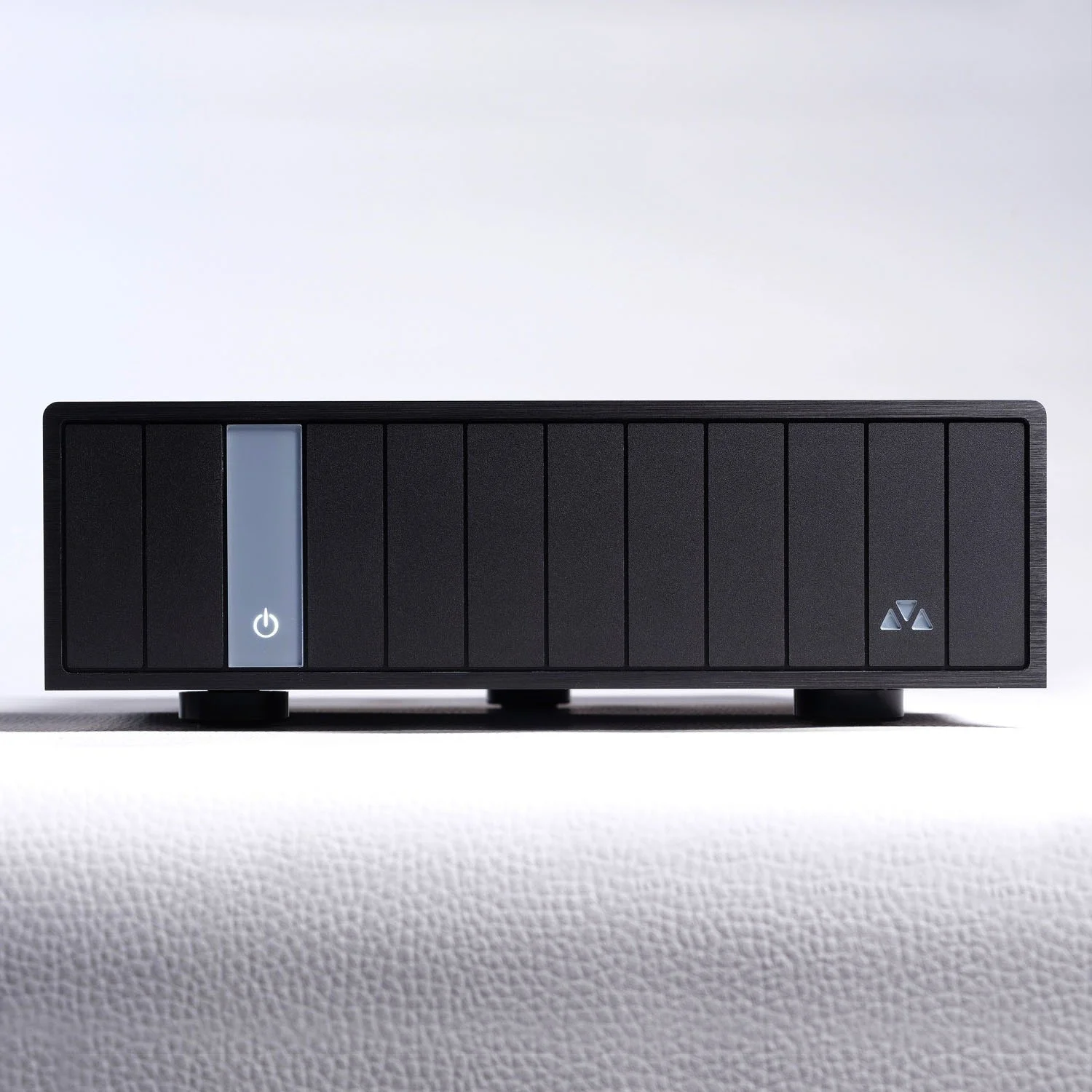
A striking example of this approach is the Soul Note Z-3, a reference-level network transport designed specifically to deliver the cleanest possible digital signal to an external DAC.
The Z-3 is conceived as a pure digital transport, meaning that it performs no digital-to-analogue conversion itself. Instead, it focuses entirely on retrieving music data from the network and delivering it to the DAC with maximum precision. By separating these functions, Soulnote aims to minimise electrical interference and timing instability within the system.
One of the most distinctive aspects of the Z-3 is its unconventional mechanical and electrical architecture. The design employs Soulnote’s characteristic non-feedback circuits, carefully separated power supplies, and a chassis structure intended to reduce vibration and electrical interference. The result is a transport that emphasises signal integrity and timing accuracy above all else.
In practical listening, such attention to detail often translates into a presentation with exceptional transparency and spatial stability. Complex recordings - large orchestral works or dense jazz ensembles - retain clarity and structure, allowing the listener to follow individual musical lines with ease.

LUXMAN NT-07 Network Player
What Listeners Often Notice
When upgrading from a basic streamer to a dedicated high-end network player, the changes are rarely dramatic in the sense of obvious tonal differences. Instead, improvements often appear in more subtle but musically meaningful ways.
Listeners frequently report:
Improved spatial realism
The soundstage becomes deeper and more stable.
Greater separation between instruments
Individual musical lines become easier to follow.
Lower perceived background noise
Silences between notes feel more natural.
Better rhythmic precision
Music flows more naturally and convincingly.
These qualities contribute to a listening experience that feels closer to the original performance.
Building a Reference Streaming Front End
As streaming continues to evolve, the digital front end of an audio system deserves the same level of care traditionally given to analogue sources.
A thoughtfully designed streaming system might combine a dedicated transport such as the Métronome DSS or the Soul Note Z-3 with a carefully chosen DAC. In this configuration, each component focuses on its specific role: the network player retrieves and delivers the digital signal, while the DAC performs the delicate task of converting that signal into analogue music.
When executed well, this approach allows streaming to offer both the convenience of modern technology and the musical refinement expected from true high-end audio.