

There is something rather special about a well-designed step-up transformer (SUT). It is a deceptively simple, entirely passive component, yet it can have a profound influence on the performance of a vinyl playback system. For many enthusiasts, it is also one of the most rewarding ways to extract the full potential of a high-quality Moving Coil (MC) cartridge.
So why consider a step-up transformer when modern phono stages increasingly offer dedicated MC inputs?
The answer lies in the way an MC cartridge generates its signal, the challenge of amplifying extremely small voltages without introducing noise, and the importance of matching the cartridge electrically to the amplification that follows.
A small signal deserves special attention
Unlike a Moving Magnet cartridge, which typically produces an output of several millivolts, a low-output MC cartridge may deliver just 0.2–0.4mV. This is an exceptionally small electrical signal, generated by tiny coils moving within a magnetic field.
The challenge is not simply to make this signal louder. It is to amplify it without losing the delicate information contained within it: the leading edge of a piano note, the decay of a cymbal, the texture of a singer's voice or the subtle spatial cues that help recreate the acoustic environment of a recording.
An active MC phono stage uses additional electronic amplification to bring the cartridge signal up to a suitable level. A step-up transformer takes a different approach. Through electromagnetic induction, it increases the voltage passively, without requiring an external power supply or adding an active gain stage.
The resulting signal is then fed into a conventional Moving Magnet (MM) phono stage, which provides the remaining amplification and RIAA equalisation.
This is an important distinction: the transformer does not replace the phono stage. It allows the MC cartridge to work with an MM input, using a different approach to the first stage of amplification.
How does a step-up transformer actually work?
At its heart, a transformer consists of two windings around a magnetic core. The primary winding receives the very small signal from the cartridge, while the secondary winding delivers a higher-voltage signal to the MM phono input.
The relationship between the number of turns in these windings determines the voltage increase.
For example:
A 1:10 ratio provides approximately 20dB of voltage gain.
A 1:15 ratio provides approximately 23.5dB.
A 1:20 ratio provides approximately 26dB.
Consider a cartridge producing 0.3mV. A 1:10 transformer ideally raises this to 3mV, while a 1:20 transformer raises it to 6mV.
There is, however, another important consequence: the impedance presented to the cartridge changes with the square of the turns ratio.
With a conventional 47kΩ MM input, the approximate load seen by the cartridge becomes:
Transformer ratio → Reflected cartridge load
1:10: 470Ω
1:15: 209Ω
1:20: 117.5Ω
This is where the real art of transformer matching begins…
Matching: the key to getting it right
A transformer should never be selected on gain alone. The cartridge's internal impedance, output voltage, transformer ratio, primary inductance and the input characteristics of the MM phono stage all need to be considered together.
A cartridge with a 5Ω internal impedance, for example, may work particularly well with a different transformer configuration from one with a 40Ω internal impedance.
Audio Note recommends an input impedance approximately three to four times the cartridge's internal impedance as a useful starting point, although the optimum can vary with the cartridge design. This is not an absolute rule, but it illustrates why matching matters.
If the cartridge is loaded too heavily, the sound can become constrained, with reduced high-frequency extension and a sense of lost musical freedom. Too little damping can produce a lighter, less controlled presentation.
The transformer itself must also be designed for the electrical characteristics of the source and load. Its core material, winding geometry, inductance and parasitic capacitance all influence its frequency response and behaviour.
These are not merely engineering details. They can determine whether the resulting sound is open, dynamic and natural, or whether it feels restricted and less convincing.
Three approaches to transformer design
At Walden, we represent three manufacturers whose approaches to MC step-up transformers are particularly interesting: Consolidated Audio, Audio Note and Aurorasound.
a. Consolidated Audio
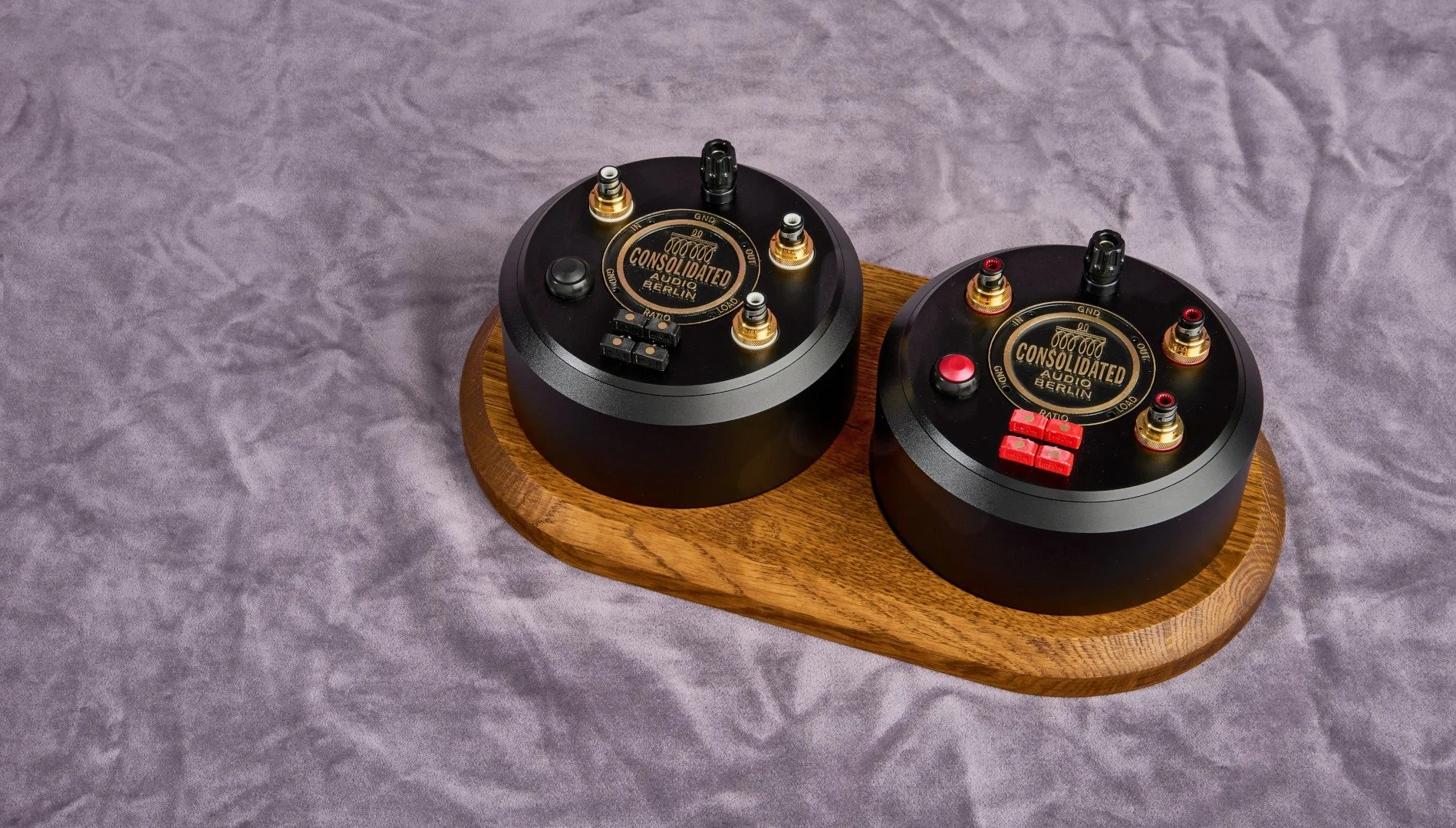
The German manufacturer Consolidated Audio, led by electrical engineer Michael Ulbrich, has developed an unusually flexible approach to MC transformer design.
Its Monster Can is available with different core materials, including Hi-Nickel (mu-metal) and nanocrystalline cores. Customers can also choose primary inductance, turns ratio and winding material, including copper and silver.
This flexibility is important because it allows the transformer to be configured around the cartridge rather than expecting the cartridge to adapt to a fixed design.
The nanocrystalline version is particularly interesting. In his February 2025 review for Stereophile, Alex Halberstadt described its presentation as exceptionally spacious, fluid and effortless, with impressive scale and texture. Comparing it with the Hi-Nickel version, he also observed meaningful differences in tonal character and musical presentation. [1]
b. Audio Note
Audio Note has a long-standing tradition of using transformers to interface its low-output MC cartridges with MM phono stages.
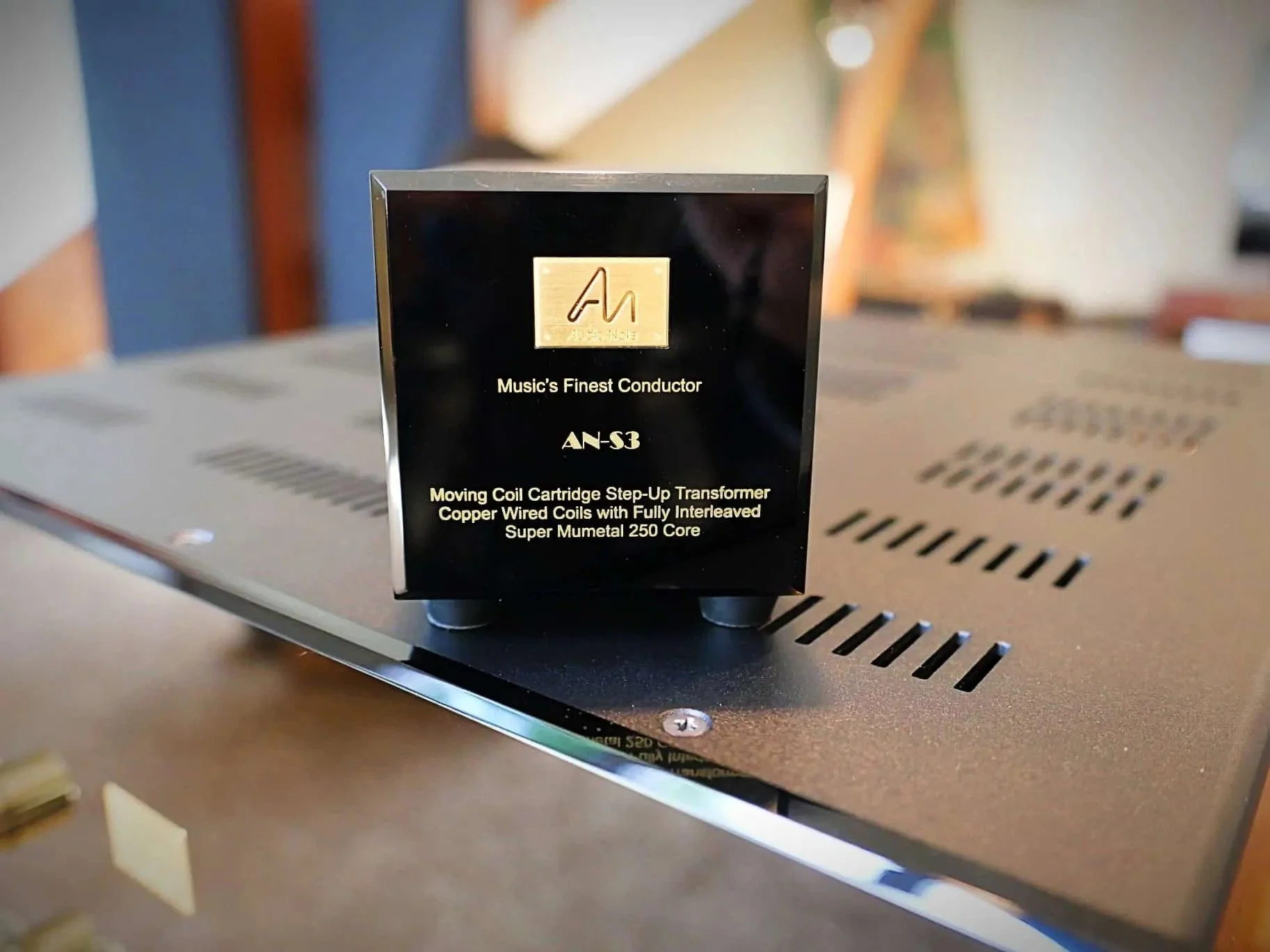
Its AN-S series features proprietary transformers, carefully selected core materials and different impedance configurations. The AN-S3, for example, uses laminated Super Mumetal 250 cores, wound with 99.99% pure copper wire and housed in Mumetal screening canisters.
The range is available in different input impedance versions, allowing a closer match to the cartridge's electrical characteristics.
Audio Note's philosophy is that the transformer should be considered an integral part of the analogue system, rather than simply an accessory to provide extra gain.
c. Aurorasound
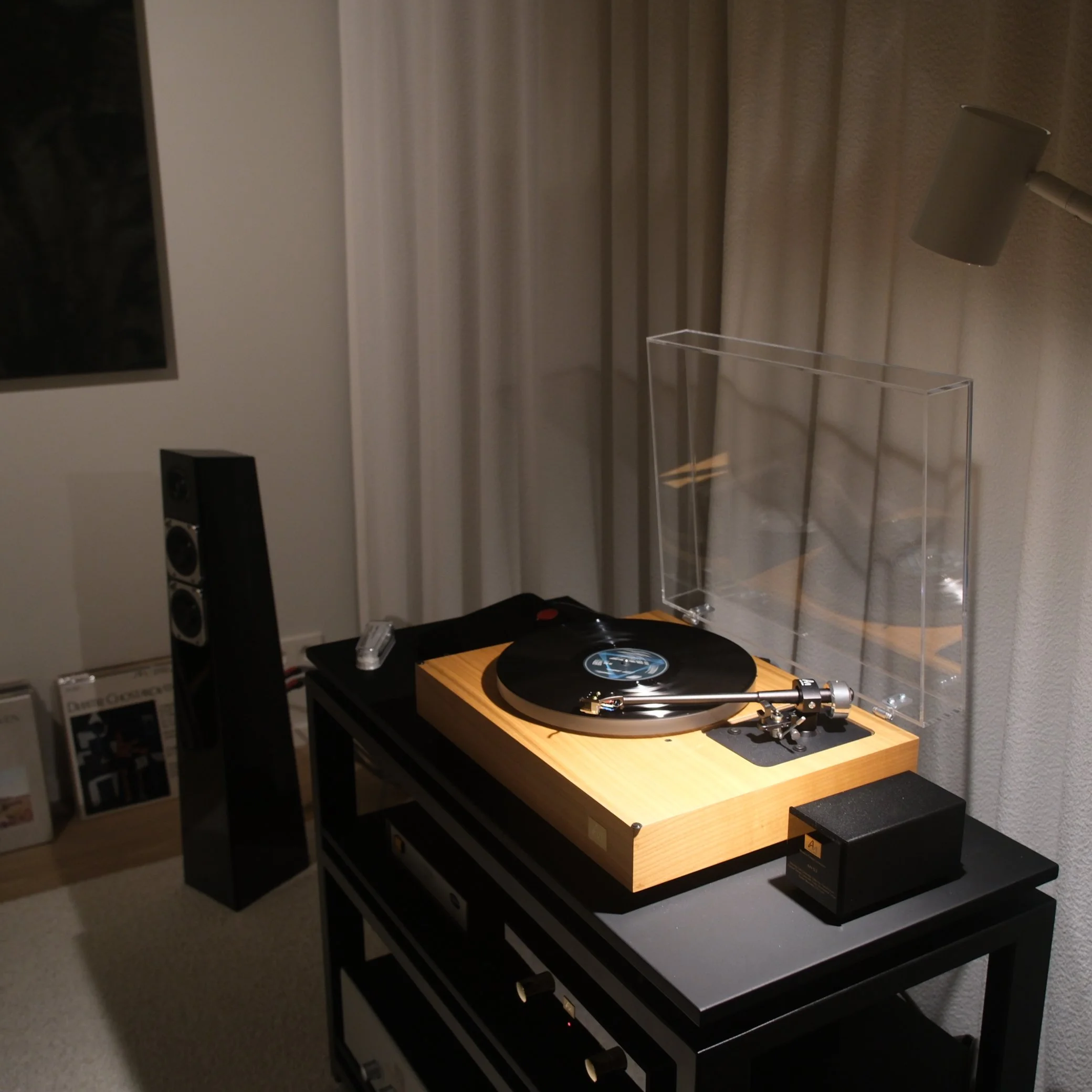
Aurorasound takes another interesting approach, combining Japanese engineering with Swedish Lundahl transformer technology.
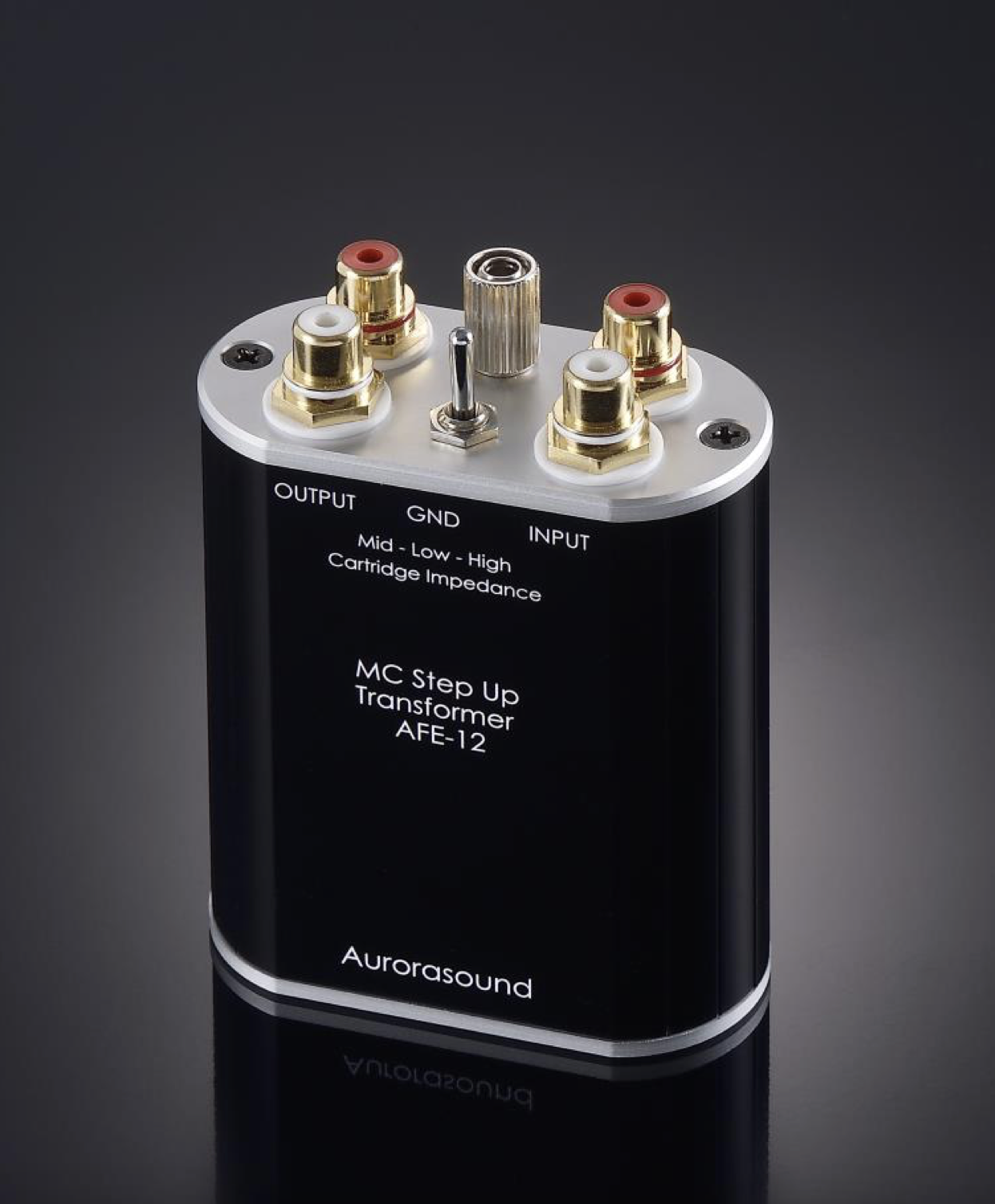
The AFE-12 is a compact MC step-up transformer with three selectable cartridge impedance ranges: Low (0.7–10Ω), Mid (11–30Ω) and High (31–100Ω).
It uses a Lundahl amorphous cobalt-core transformer and a dual-coil construction intended to improve immunity to external magnetic interference. Aurorasound also fills the enclosure with cotton to reduce the influence of vibration.
What does it bring to the music?
Ultimately, the reason to consider a step-up transformer is not its technical specification. It is what happens when the stylus meets the record.
A well-matched SUT can deliver a remarkably quiet and composed presentation, allowing low-level musical information to emerge more clearly. This can translate into better perceived dynamics, more convincing instrumental texture, greater spatial definition and a stronger sense of musical flow.
The improvements are not necessarily about making the sound brighter or more detailed. Rather, they can be about preserving the relationships between musical elements: the body of a piano, the natural decay of a string instrument, the intimacy of a voice or the interplay between musicians.
Independent reviews offer some interesting illustrations.
In his review of the Aurorasound AFE-12, Paul Rigby of The Audiophile Man reported a substantial reduction in perceived background noise, improved vocal focus and greater clarity of instrumental detail when using the transformer with an MM phono stage. [2]
Similarly, Marc Phillips, reviewing the Audio Note AN-S3 for Part-Time Audiophile in August 2026, found that careful impedance matching and positioning were crucial. In his system, the transformer delivered a more assured, quieter and more three-dimensional musical presentation than the alternative MC phono stages he compared it with. [3]
These are listening observations rather than universal guarantees. The result will always depend on the cartridge, transformer, phono stage and the rest of the system.
Is a step-up transformer right for your system?
A step-up transformer is particularly worth considering if you own a good low-output MC cartridge and have access to a quality MM phono stage.
It can also be an attractive solution for owners of valve-based phono stages, where the additional challenge of achieving very low noise at high gain makes passive transformer coupling especially appealing.
There are, however, a few practical considerations:
Matching: Know your cartridge's output voltage and internal impedance before selecting a transformer.
Gain: Ensure the chosen ratio provides sufficient signal for your MM phono stage without excessive overload.
Loading: Remember that the MM input resistance determines the load reflected back to the cartridge.
Hum: Keep the transformer away from power supplies, mains transformers and other sources of magnetic interference.
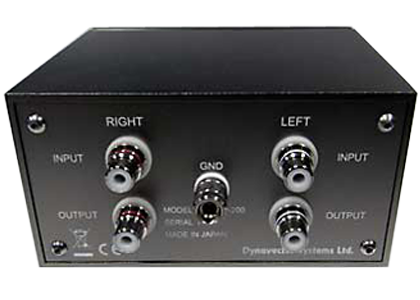
Connections: Pay attention to grounding, cable quality and the correct connection to the MM input. Never connect an SUT output to an MC input unless the manufacturer's instructions explicitly permit it.
The most important advice is to listen. Different transformers can produce different results even when their nominal specifications appear similar.
In conclusion
A step-up transformer is one of those components that reminds us why analogue reproduction remains so fascinating. It combines elegant electrical engineering with an almost intangible influence on the way we experience recorded music.
When the cartridge and transformer are properly matched, the reward can be a more natural, effortless and emotionally engaging musical presentation.
That is the magic of the step-up transformer. Not simply more gain, but the opportunity to hear more of what is already there in the record.
References and further reading
[1] Alex Halberstadt, Brilliant Corners #24: Consolidated Audio "Monster Can" & Fairchild 235 MC Step-Up Transformers, Stereophile, 27 February 2025.
[2] Paul Rigby, AFE-12 Step-Up from Aurorasound, The Audiophile Man, 19 April 2024.
[3] Marc Phillips, Audio Note UK AN-S3 Step-Up Transformer Review, Part-Time Audiophile, 16 August 2026.