

On The Secret of Musicality & The Work of Hiraga
Jean Hiraga, Psychoacoustics, and the Enduring Appeal of Broadband Loudspeakers
Modern loudspeakers promise technical perfection. Manufacturers routinely claim frequency responses from 20 Hz to 20 kHz, vanishingly low distortion, and sophisticated crossover networks designed to optimize every driver within its ideal operating range.
Yet experienced listeners often encounter a paradox: systems that measure impressively can still fail to communicate the vitality of live music.
This contradiction fascinated Jean Hiraga, one of the most influential voices in high-end audio. Through his work as editor of the French magazine L'Audiophile during the late 1970s and 1980s, Hiraga explored the relationship between measured performance and the subjective experience of music reproduction. His writing helped revive interest in simple amplifier circuits, high-efficiency loudspeakers, and listening methods that emphasized musical realism over purely technical metrics.
For Hiraga, fidelity was not merely a question of reproducing sound accurately in a laboratory sense. The real goal of a high-fidelity system, he argued, was to recreate the musical event itself; its dynamics, spatial structure, and the subtle evolution of tones as they emerge and decay in time.

Jean Hiraga’s Audio System - Source: Mono and Stereo.
Hiraga and the Search for Musical Truth
Jean Hiraga's work emerged during a period when audio engineering increasingly focused on measurements such as harmonic distortion and frequency response. While Hiraga never rejected technical measurements outright, he repeatedly emphasized their limitations.
In his writings for L'Audiophile, he argued that the ultimate test of audio equipment lies in its ability to preserve the integrity of musical expression: the dynamic contrasts, tonal textures, and spatial cues that allow listeners to perceive the atmosphere of a performance.
This perspective led Hiraga to champion technologies that had largely disappeared from mainstream hi-fi: single-ended triode amplifiers, high-efficiency loudspeakers, and horn systems derived from cinema sound. Many of these systems relied on wide-band or broadband drivers, capable of reproducing a large portion of the audible spectrum without complex crossover networks. Hiraga often praised classic designs such as the Altec 604 coaxial driver and various horn systems for their efficiency and coherence.
His advocacy did not stem from nostalgia but from careful listening. Hiraga believed that such systems preserved dynamic contrast and tonal continuity in ways that more complex designs sometimes failed to achieve.
Spectral Balance and Human Perception
A central theme in Hiraga's writing is the importance of spectral balance.
Conventional loudspeaker specifications tend to emphasize bandwidth, i.e. the ability to reproduce the lowest and highest frequencies. Yet psychoacoustic research shows that human hearing does not respond equally to all frequencies. Instead, the ear analyzes sound through overlapping perceptual filters known as critical bands.
Within these bands, the brain interprets sound largely in terms of relative energy distribution rather than absolute extension. A system with limited bandwidth can still sound natural if the balance between frequency regions remains coherent. Conversely, a system with deep bass and extended treble may sound unnatural if the midrange energy (the region most sensitive to human hearing) is distorted or uneven.
This insight helps explain a phenomenon familiar to many listeners: older audio systems with modest bandwidth can sometimes sound surprisingly musical, while technically superior systems may appear analytical or fatiguing.
For Hiraga, tonal balance was the primary criterion of realism, preceding other technical considerations.
Micro-Dynamics and the Evolution of Sound
Beyond spectral balance, Hiraga placed enormous importance on the temporal behavior of sound.
Music unfolds over time, and the ear is remarkably sensitive to the way tones evolve. The attack of a piano note, the shimmer of a cymbal, the resonance of a violin string - each contains countless small fluctuations in amplitude and harmonic structure.
Hiraga often described these variations as micro-information: the fine details that give music its expressive character. In his writings, he argued that many audio systems fail to reproduce this information because of mechanisms such as intermodulation distortion, unstable dynamic behavior, or mechanical resonances in loudspeaker drivers and cabinets. These distortions may remain subtle in conventional measurements but become audible in complex musical passages where multiple frequencies interact simultaneously.
When these cues are lost, music can appear flattened and lifeless, even if the system measures well.

Internals of the Audio Note 300B Meishu Tonmeister. What makes this amplifier so special, in our view at least, is its capability to offer beautiful tonality together with amazing micro-energy in the musical presentation.
Simplicity and Coherence
These observations led many designers associated with the L'Audiophile movement to favor relatively simple signal paths.
Complex multi-way loudspeakers typically divide the audio spectrum between several drivers using crossover networks composed of inductors, capacitors, and resistors. While this approach allows each driver to operate within its optimal frequency range, it also introduces phase shifts and time delays that can affect the coherence of the reproduced sound field.
Broadband loudspeakers take a different approach. A single driver reproduces most of the audible spectrum, eliminating crossovers in the critical midrange where the ear is most sensitive.
This architecture offers several potential advantages:
A single acoustic source
Consistent phase behavior
Uniform radiation patterns
Preservation of temporal coherence
For many listeners, these qualities translate into a presentation that feels more immediate and natural.
Supravox Alizee Heritage Fieldcoil Speaker
Supravox and the Broadband Tradition
The French manufacturer Supravox represents one of the longest-standing examples of this design philosophy. Founded in the 1950s, the company has specialized in high-efficiency loudspeaker drivers capable of covering a wide frequency range with minimal filtering.
Supravox drivers typically employ lightweight paper diaphragms, carefully tuned suspensions, and powerful magnet systems to achieve high sensitivity and fast transient response. These design choices reflect the priorities emphasized by Hiraga and other advocates of high-efficiency systems: dynamic responsiveness, tonal coherence, and minimal mechanical inertia.
When implemented properly, such drivers excel in the midrange, the region where the majority of musical information resides. Voices and acoustic instruments often appear vivid and lifelike, with a sense of presence that sounds immediate.
Building a Reference Streaming Front End
As streaming continues to evolve, the digital front end of an audio system deserves the same level of care traditionally given to analogue sources.
A thoughtfully designed streaming system might combine a dedicated transport such as the Métronome DSS or the Soulnote Z-3 with a carefully chosen DAC. In this configuration, each component focuses on its specific role: the network player retrieves and delivers the digital signal, while the DAC performs the delicate task of converting that signal into analogue music.
When executed well, this approach allows streaming to offer both the convenience of modern technology and the musical refinement expected from true high-end audio.
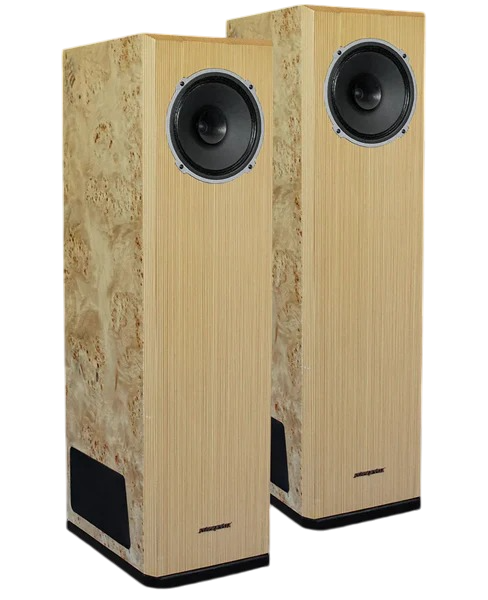
Tonapparate Model 50
A modern interpretation of this tradition can be found in the handcrafted loudspeakers produced by Tonapparate, particularly the Model 50.
At the heart of this design lies an 11-inch Alnico wide-range driver with an ultra-light diaphragm, responsible for reproducing the majority of the audible spectrum. Rather than relying on complex filtering, the system uses a gentle 6 dB per octave crossover, allowing the primary driver to remain largely unobstructed in the critical midrange.
A small compression driver mounted in a wood-and-aluminum horn extends the highest frequencies, but the sonic character remains fundamentally defined by the large wide-range driver.
The loudspeaker achieves a sensitivity of roughly 98 dB per watt, making it well suited for low-power amplifiers such as single-ended triode designs. The cabinet itself is constructed from solid wood with an internal spruce structure and a vented two-chamber design that allows careful tuning of the low-frequency response.
Conceptually, the Model 50 reflects many of the ideas that Hiraga explored decades earlier. Its architecture prioritizes efficiency, simplicity, and the integrity of the midrange—the frequency region where human hearing is most sensitive and where the emotional core of music resides.
Rather than pursuing technical complexity, the design focuses on preserving the continuity of the musical signal from amplifier to diaphragm.

Tonapparate Model 50 Loudspeaker
Hearing the Whole Note
Hiraga often emphasized a deceptively simple principle: hearing a note is not enough. What matters is hearing the entire life of the note.
When a piano key is struck, the sound does not simply appear and disappear. It blooms, resonates, interacts with the acoustics of the hall, and gradually fades into silence. These transitions - sometimes lasting several seconds - are essential to the emotional language of music.
If an audio system truncates these decays or masks their delicate fluctuations, something vital is lost. The music may still be recognizable, but the sense of presence and atmosphere disappears.
For Hiraga, the ability to reproduce these evolving tonal structures was among the most revealing tests of an audio system.
Conclusion
The continuing fascination with broadband loudspeakers reflects more than nostalgia for vintage technology. It reveals a deeper insight into the relationship between measurement and perception.
Modern loudspeakers may achieve extraordinary technical performance, but the human ear remains sensitive to qualities that are difficult to quantify: tonal balance, dynamic nuance, and the natural evolution of sound in time.
Jean Hiraga understood this perhaps better than anyone. His work reminds us that high fidelity is not simply about reproducing frequencies—it is about conveying the living structure of music.
And sometimes, the most convincing path to that goal lies not in complexity, but in coherence.