

An Audio Blog by Walden - Ideas & Insights on Audio & Good Sound

Tube Soul, Transistor Muscle: The Appeal of Hybrid Amplifiers
Among audiophiles, the question of amplification often leads to a familiar debate: tube or solid-state? Both technologies have shaped high-fidelity audio for decades, each with its own strengths. Yet a third category has attracted increasing attention... hybrid amplifiers, designs that combine elements of both approaches.
Among audiophiles, the question of amplification often leads to a familiar debate: tube or solid-state? Both technologies have shaped high-fidelity audio for decades, each with its own strengths. Yet a third category has attracted increasing attention... hybrid amplifiers, designs that combine elements of both approaches.
Hybrid amplification can be an intriguing concept. Though this is something of an oversimplification, the idea is to combine the musical character often associated with vacuum tubes with the control and efficiency of semiconductor circuits.

Hybrid designs sometimes evoke mixed feelings and ambiguous judgments. One only has to think of hybrid cars. Originally conceived with fuel economy in mind, they rarely capture the imagination of true car enthusiasts. Quite the opposite, in fact. The purist will usually gravitate either toward a proper internal combustion engine or - at the other end of the spectrum - the instant torque and brutal acceleration of a fully electric car.
Hi-fi may not be so different. The purist listener can also be skeptical of hybrid solutions, occasionally dismissing them as something of a Frankenstein creation: an attempt to merge two philosophies that perhaps ought to remain separate. Until recently, I must admit I belonged to that camp myself.
That view changed, however, after spending considerable time listening to several amplifiers from Aurorasound. But more about that in a moment.
Tube vs. Solid-State Amplification
Vacuum tube amplifiers formed the foundation of early high-fidelity systems and remain highly valued by many enthusiasts today. Listeners often appreciate their tonality and ease-to-the-ear presentation.
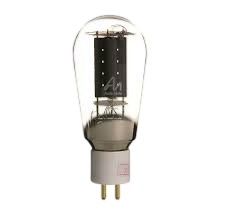
From a technical perspective, tubes tend to produce predominantly even-order harmonic distortion, which can be perceived as musically consonant at moderate levels. When a tube amplifier introduces small amounts of distortion, the additional frequencies it generates occur at multiples of the original musical tone; frequencies that the human ear often interprets as harmonically related rather than harsh or dissonant.
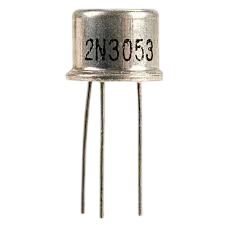
Solid-state amplifiers, based on transistor technology, became dominant from the 1970s onward. They typically offer higher efficiency, lower measured distortion, and greater output power. These characteristics allow them to drive a wider range of loudspeakers.[1]
Both approaches offer clear strengths. Tube amplifiers can provide a distinctive musical presentation, while solid-state designs often deliver precision, reliability, and higher power output. Hybrid amplifiers were developed as an attempt to bring some of these advantages together.
What Is a Hybrid Amplifier?
In hybrid designs, the amplifier is typically divided into two functional sections.
The input or pre-amplification stage often uses vacuum tubes. At this stage the audio signal is still very small, and the circuit shapes the character of the signal before further amplification.
The output stage, which must deliver significant current to the loudspeakers, is often handled by transistors. Solid-state devices are particularly well suited to this role because they provide high current capability and stable operation with complex speaker loads. As discussed below, however, this approach is not fixed; some designers and manufacturers explore alternative configurations.
[1] Engineering analyses such as those presented in Audio Power Amplifier Design by Douglas Self document the technical advantages and measurement performance of modern transistor amplifier topologies.
Diagram – Typical Hybrid Amplifier Signal Path
Audio Source
│
▼
Tube Input Stage
Voltage Gain / Tonal Characteristics
│
▼
Solid-State Output Stage
High Current Drive
Transistors / MOSFETs
│
▼
Loudspeakers
A common hybrid amplifier architecture therefore uses vacuum tubes in the input stage and solid-state devices in the output stage. This arrangement allows designers to combine the sonic behaviour of tube circuits with the power and efficiency of modern transistor amplification.
The Attraction of Hybrid Amplifiers
Hybrid amplifiers are often attractive because they bring together practical advantages from both tube and solid-state technologies. In many systems, this combination can offer a balanced solution that works well with a wide range of loudspeakers and listening preferences.
One important factor is versatility. Because the output stage in many hybrid designs relies on transistor circuitry, these amplifiers are often capable of delivering the current and stability required to drive loudspeakers that might be demanding for lower-powered tube amplifiers.
From a listening perspective, hybrid amplifiers are frequently appreciated for the balance they can achieve. In my experience, they combine the control and clarity associated with solid-state amplification with the tonal character that is generally valued in tube circuits.
While many designs place tubes in the input stage and transistors in the output stage, some manufacturers explore the reverse configuration. In these designs, semiconductor circuits handle the low-noise front end, while tubes are used in the output stage. This allows designers to combine the precision of transistor circuitry with the distinctive behaviour of classic output tubes.
A Japanese Perspective: Aurorasound
One manufacturer exploring hybrid amplifier design in particularly thoughtful ways is Aurorasound. Founded by engineer Shinobu Karaki, the company has developed a reputation for carefully engineered analogue electronics, especially phono stages and amplifiers.

The Aurorasound HFSA-01 Integrated Amplifier.
The Aurorasound HFSA-01 integrated amplifier provides a good example of a modern hybrid approach. It combines semiconductor circuitry with EL84 output tubes to deliver approximately 14 watts per channel and includes a built-in phono stage for moving-magnet cartridges, along with traditional tone controls. The result is an amplifier that integrates easily into vinyl-based systems.
Despite its relatively compact appearance, the HFSA-01 sounds remarkably dynamic. At the same time, it conveys a sense of fluidity and delicacy that many listeners associate with Aurorasound designs. In fact, the “Aurorasound sound” is difficult to describe. Each time I listen to Aurorasound amplifiers, the presentation feels fluid and distinctly analogue in character—qualities that are immediately recognisable, even if they resist simple technical explanation.
Another amplifier created by Aurorasound that employs a hybrid concept is the Aurorasound PADA-300B. In the PADA-300B, discrete transistors form the low-noise front-end stage, where they help achieve an excellent signal-to-noise ratio, low distortion, and wide bandwidth. The signal is then coupled through an inter-stage transformer to a push-pull output stage built around the classic directly heated 300B triode. This arrangement allows the amplifier to benefit from the precision of transistor circuitry while preserving the sonic characteristics of the 300B tube in the output stage.

The amplifier produces around 28 watts per channel in push-pull configuration and operates without overall negative feedback, relying instead on the inherent linearity of the 300B tubes and high-quality output transformers from the Swedish manufacturer Lundahl. Independent power supply sections for the front-end and output stages further help maintain stability and dynamic headroom during demanding musical passages.
In practice, the 28-watt specification appears rather conservative. In my experience, these monoblocks provide ample power and current to drive speakers that are not particularly efficient or that can be challenging loads for many tube amplifiers.
The design has received recognition in specialist audio publications and has been highlighted in reviews by magazines such as Stereo Sound in Japan. In addition, the PADA-300B has been awarded the Diapason d’Or, one of the most respected distinctions in European high-end audio.

Aurorasound PADA 300B Hybrid Monoblocks on display at Walden High-End Audio.
Listening Still Matters Most
Ultimately, amplification is not only about topology. Two hybrid amplifiers can sound very different depending on the quality of their circuit design, components, and power supply.
For listeners building a high-end system, hybrid amplifiers offer an interesting path between traditional tube amplification and modern solid-state designs. They combine elements of both technologies in ways that can provide both musical engagement and practical versatility.
And perhaps the comparison with hybrid cars is not entirely fair after all. In audio, at least, the right hybrid design does not necessarily dilute two worlds—it can reveal how thoughtfully combining them may produce something uniquely compelling.
As always in high-fidelity audio, the most meaningful evaluation remains the same: sitting down, pressing play, and listening to music.
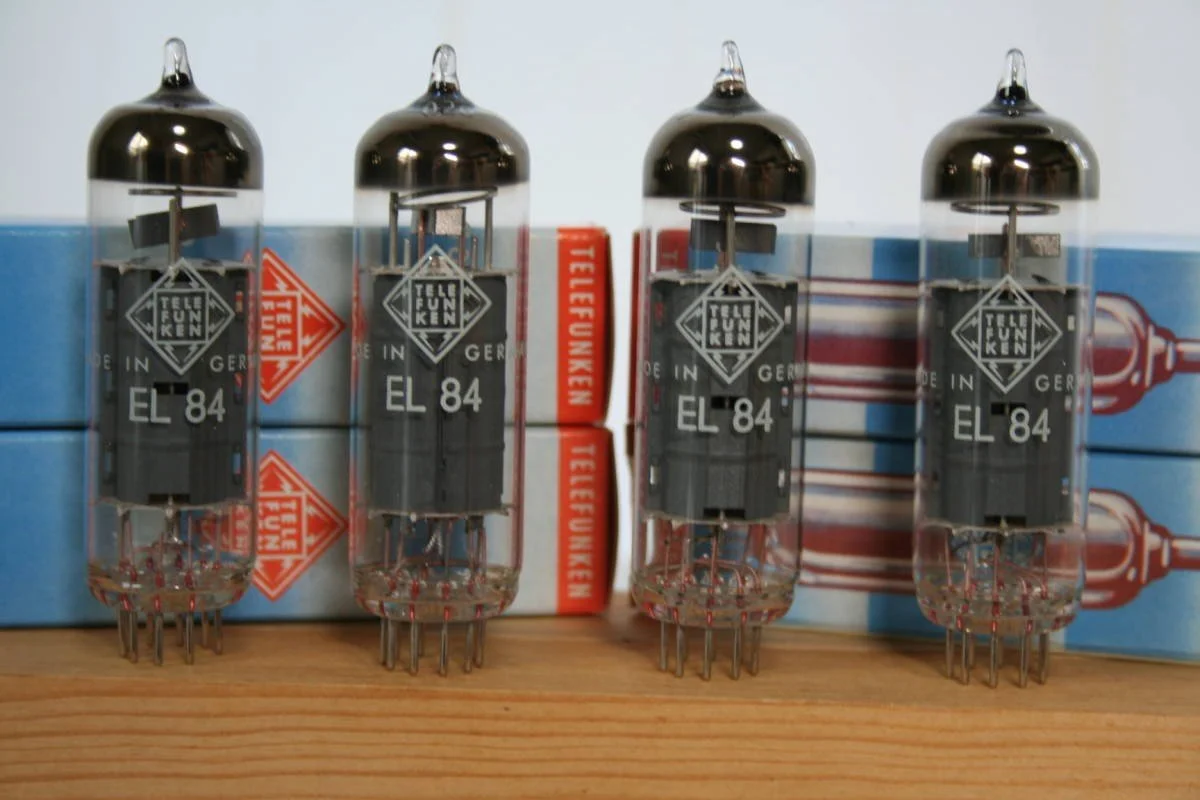
The EL84. Gracious Sound from a Small Tube.
Very often, it can be difficult to predict how an amplifier will sound. We assume that by reading enough reviews and analyzing technical specifications, we understand how a piece of audio equipment will perform. Given how significant the investment can be, the risk of a wrong choice is considerable. Yet somehow, that risk feels smaller when it comes to an EL84 amplifier.
Very often, it can be difficult to predict how an amplifier will sound. We assume that by reading enough reviews and analyzing technical specifications, we understand how a piece of audio equipment will perform. Given how significant the investment can be, the risk of a wrong choice is considerable. Yet somehow, that risk feels smaller when it comes to an EL84 amplifier. At least in my experience. They tend to sound inherently musical, with a certain natural ease that becomes quite addictive over time.
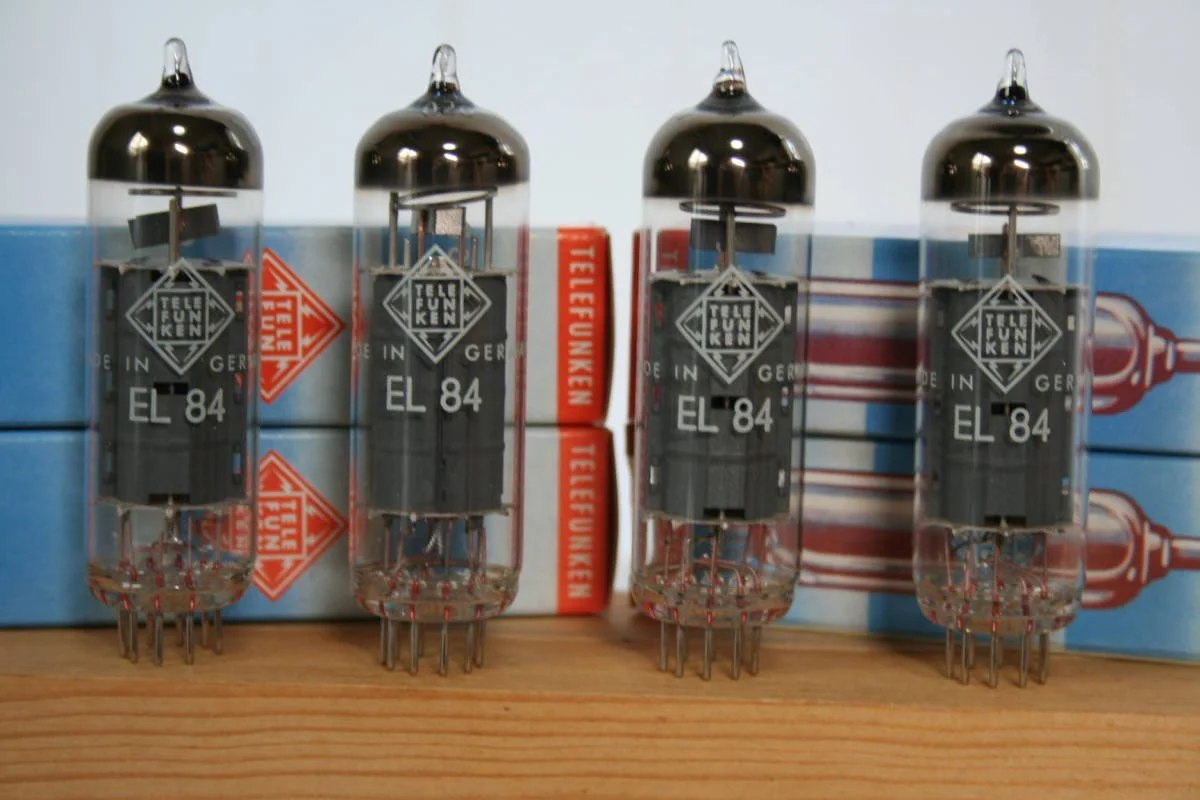
Of course, the character of an amplifier is never determined solely by the type of tubes it uses. Design, transformers, power supply, and implementation all matter. And yet, with EL84s, there often seems to be something consistent — almost an exception to that rule.
The EL84 – A European Design
The EL84 was introduced in the early 1950s by Philips as a compact power tube for radios and the growing hi-fi market. It was small, efficient, and capable of producing meaningful output without large, complicated circuitry. In the United States it became known as the 6BQ5.
Because it was affordable and reliable, the EL84 quickly appeared in European home audio equipment. It later became famous in guitar amplifiers — especially those built by Vox.
But beyond history and popularity, the EL84 earned loyalty for another reason: balance. It tends to present music with clarity and energy, yet without exaggeration. It does not demand attention. It supports the music.
That character is probably one of the reasons why serious designers still return to it.
The Audio Note OTO SE 35th Anniversary: A Familiar Voice Refined
Audio Note’s most popular amplifier, the OTO, also utilizes EL84 tubes. The amplifier was introduced in 1991 – a time when the global audio market was turning toward digital and tube amplifiers had nearly become relics of the past – with the aim of creating a simple yet highly musical, high-quality amplifier for the discerning music lover.
Thirty-five years later, the Audio Note OTO SE 35th Anniversary Edition builds upon the strengths of the original OTO.

At its core are four EL84 tubes, delivering approximately 8 watts per channel. The amplifier operates in pure Class A and follows a single-ended topology – an approach many listeners value for its coherence and tonal integrity.
For the 35th Anniversary version, the overall recipe remains familiar, yet it has been further refined. The output transformers are newly designed and wound in-house. The power supply now incorporates a choke to enhance stability and improve bass control. Internal wiring and shielding have been revised. The phono stage has been updated for greater sensitivity, and the additional line stage previously required in the phono model has been eliminated, simplifying the signal path.

Aurorasound HFSA-01
Mr. Shinobu Karaki, founder and mastermind of Aurorasound, also relies on the EL84 tube in the Aurorasound HFSA-01, a compact integrated amplifier with charming vintage looks.
The amplifier features a hybrid design, utilizing EL84 tubes in the power stage; this is quite different from most hybrid amplifiers, where tubes are typically implemented in the preamplifier stage. Here, the tubes operate in a push-pull configuration, delivering roughly 14 watts per channel. This provides greater headroom and broader compatibility with a range of loudspeakers.

Unlike many minimalist tube amplifiers, the HFSA-01 includes a built-in phono stage and tone controls. These are not afterthoughts; they are thoughtfully integrated, making the amplifier practical without compromising its core identity.
In use, the HFSA-01 feels composed and versatile. There is a sense of control in the lower frequencies and a clean presentation through complex passages. Yet the EL84 character remains – quick, open, and musically direct. The HFSA-01 offers amazing musicality at (and beyond) its price point.
A Japanese Classic: The LUXMAN SQ‑N150
The LUXMAN SQ‑N150 is a compact integrated amplifier that combines classic tube design with modern usability. It features four EL84 tubes in a push-pull output stage, paired with two ECC83 input tubes, delivering roughly 10 watts per channel into 6 ohms.

Unlike many minimalist tube amplifiers, the SQ‑N150 includes a built-in phono stage (MM/MC), multiple line inputs, tone controls, and a headphone output — all thoughtfully integrated. As with all Luxman products, component quality and reliability are exceptionally high.
In practice, the amplifier feels confident, balanced, and surprisingly powerful. It demonstrates how careful design can make this small tube shine: refined and extremely musical.
* * *
The EL84 is likely to remain relevant among audio aficionados for many years to come. When implemented well, it delivers proportion; not excess.
The Audio Note OTO SE 35th Anniversary Edition, the Aurorasound HFSA-01, and the Luxman SQ‑N150 illustrate different ways the EL84 can be used in today’s high-end audio. One emphasizes single-ended simplicity and transformer craftsmanship, another explores push-pull power and hybrid flexibility, and the third balances traditional tube sound with modern features. All three rely on a tube introduced more than seventy years ago.
If you want to understand the appeal of this little tube, visit Walden High-End and hear it for yourself!

Explore Walden Products & Brands
OUR PRODUCTS
Turntable Products: Turntables - Tonearms - Phono Cartridges - Step-Up Transformers - Vinyl Cleaning - Turntable Accessories - Turntable Plinths & Overhauls
Cables: Power Cables - Digital Interconnects - USB Cables - Ethernet Cables - Analogue Interconnects - Speaker Cables - Phono Cables
Loudspeakers: Floor Standing Speakers - Monitor Speakers - Center Speakers - On-Wall Speakers - Subwoofers
Amplifiers: Integrated Amplifiers - Pre-Amplifiers - Power Amplifiers - Phono Stages - Headphone Amplifiers - Tubes/Valves
Accessories: Audio Furniture - Audio Isolation - Acoustic Treatment - Speaker Stands
Streaming: Network Filtering - Network Switches - Streaming Transports
OUR BRANDS
Acoustical Systems | AIM | APL Hi-Fi
Audio Note | Audio-Technica | Aurorasound
C.E.C. | Chord Electronics | Consolidated Audio
DS Audio | Dynavector Systems } Elipson | EMT
Essential Audio Tools | First Watt | Furutech
Guru Audio | HANA | iFi audio | Isol-8
Moonriver Audio | Mudra Akustik | Knosti | Kuzma
Little Fwend | LUXMAN | Lyngdorf Audio
Nagaoka | Norstone | OePhi Acoustics | Onkyo
Origin Live | Pass Labs | PlenQ
PSI Audio | Rega | REL Acoustics | Solidsteel
Sorane | Spendor | Soulnote | Sugden Audio
Supravox | Takumi | Tellurium Q