

LUXMAN D-100 CENTENNIAL
If you have a weakness for Japanese technology at its very best, it is difficult to ignore LUXMAN. Few names in high-end audio can draw upon a history as long and as rich. The story began in 1925, and over the course of a century LUXMAN has lived through virtually every major transition in audio: from radio to hi-fi, from valves to transistors, from analogue to digital, and from the Compact Disc to SACD and high-resolution music. Rather than simply abandoning the past whenever a new technology appears, LUXMAN has consistently built upon what it has learned before. It is a distinctly Japanese approach: progress, certainly, but carefully considered, with respect for proven ideas and accumulated experience.

This philosophy becomes apparent when the LUXMAN D-100 CENTENNIAL arrives. At 25.4 kg, this is no lightweight digital player that happens to look impressive. It has the physical presence of a genuine flagship. At first sight, its exterior recalls the D-10X, but the D-100 is much more than an evolutionary update. LUXMAN has clearly spared neither effort nor engineering ambition in creating a CD/SACD player and DAC worthy of carrying the CENTENNIAL badge.
A short technical X-ray
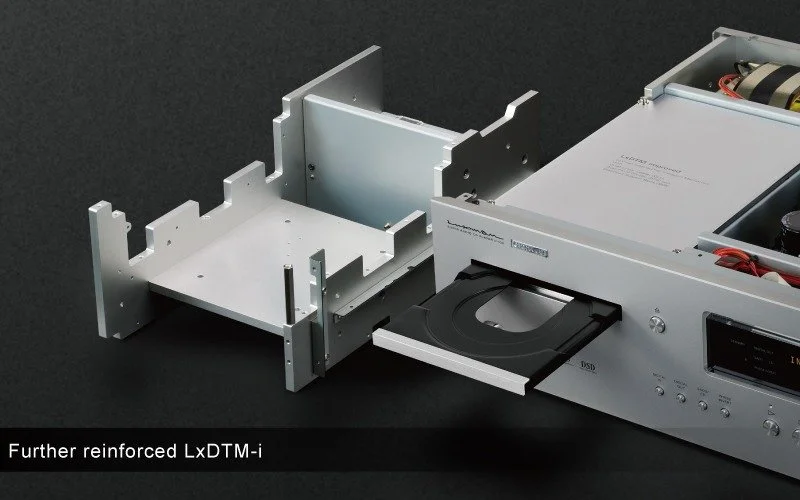
At its heart sits an improved version of LUXMAN's proprietary LxDTM-i disc transport, housed in an exceptionally rigid mechanical structure using substantial aluminium and steel elements. Digital conversion is handled by two ROHM BD34302EKV DAC chips in dual-mono configuration, while the analogue output stage introduces LUXMAN's latest LIFES 1.1 feedback engine to a disc player for the first time. Add ultra-low-phase-noise clock circuitry, a substantial CI-core transformer, independent left/right rectification and 40,000 μF of filter capacitance, and it becomes clear why the D-100 weighs more than many complete amplifiers. This is Japanese craftsmanship of the highest order, combined with an unmistakable respect for the natural, unforced musical character for which LUXMAN has become known.
Listening to the D-100 CENTENNIAL
For our listening sessions, we used the LUXMAN L-100 CENTENNIAL as well as other amplifiers, including the Audio Note Meishu Tonmeister 300B and OTO SE Signature 35th Anniversary. Loudspeakers included the Audio Note AN-E SPe HE and the Spendor 3/1 monitors. This gave us a broad range of perspectives on the D-100's character.
What immediately stands out is the extraordinary clarity and realism of the presentation. Not clarity in the sense of an artificially sharpened or analytical sound, but a remarkable ability to make recorded instruments feel tangible. Jazz at the Pawnshop, recorded live at Stockholm's Stampen Jazz Club on 6 and 7 December 1976, is of course one of those recordings that has become a familiar reference among audiophiles. Through the D-100, however, the performance became almost disconcertingly present. The audience, the musicians and the acoustic of the venue formed a convincing whole, with instruments appearing tactile and startlingly real. There was a sense of being transported back to that Stockholm club in 1976. At its best, the experience made it genuinely difficult to reconcile what we were hearing with the fact that the source was a Compact Disc. The D-100 does not seem interested in impressing through spectacular hi-fi effects; its greater achievement is to make the musical event itself feel more believable.
The D-100 as a full-fledged DAC
The D-100 CENTENNIAL is also far more than a magnificent SACD/CD player. Its DAC section makes it a highly capable digital hub for a modern high-end system. USB accepts PCM up to 768 kHz/32-bit and DSD up to 22.5 MHz, while the coaxial and optical S/PDIF inputs accept PCM up to 192 kHz/24-bit and DSD 2.8 MHz via DoP. LUXMAN also provides three PCM filters and two DSD filters, allowing a degree of fine adjustment to suit both system and personal taste.
We tested this capability with a Wattson Emerson Digital, connected via a Tellurium Q Ultra Silver RCA digital cable to the D-100's S/PDIF coaxial input. The combination worked flawlessly and, more importantly, allowed us to bring the D-100's exceptional conversion and analogue output stage to another digital source. For owners of a network streamer, computer or dedicated digital transport, this considerably broadens the D-100's appeal: it can serve as the centrepiece for both an existing disc collection and today's high-resolution digital music.

Key specifications at a glance
Disc playback: 2-channel SACD and CD
DAC architecture: 2 × ROHM BD34302EKV, dual mono
USB: PCM up to 768 kHz/32-bit; DSD up to 22.5 MHz
Coaxial/optical: PCM up to 192 kHz/24-bit; DSD 2.8 MHz via DoP
Digital inputs: USB, 1 × coaxial, 2 × optical
Analogue outputs: balanced XLR and unbalanced RCA
Analogue output stage: fully balanced discrete circuitry with LIFES 1.1
Weight: 25.4 kg
Dimensions: 440 × 154 × 420 mm

The LUXMAN D-100 CENTENNIAL is, in every sense, a statement component. It celebrates one hundred years of LUXMAN, but it does not do so by looking backwards alone. Instead, it brings together a century of engineering experience and applies it to the way many of us listen today: SACD, CD, streaming and high-resolution files, all through one extraordinarily serious digital source. For the music lover with a substantial disc collection who also wants a truly reference-class DAC, the D-100 CENTENNIAL may be one of the most compelling expressions yet of what LUXMAN does best.